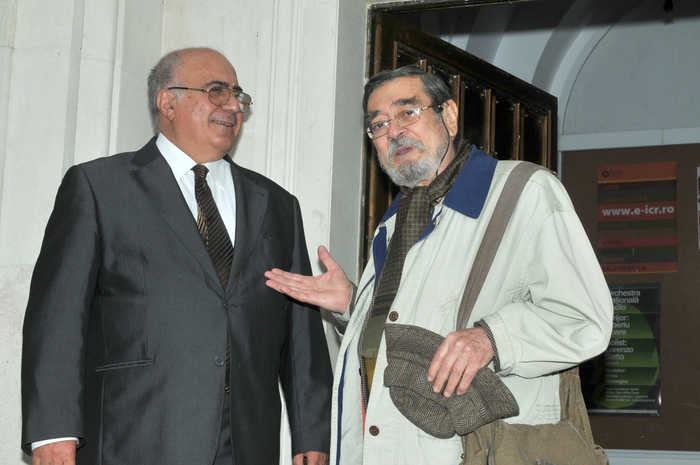
1.ConstantinJoja(n. 9 iulie 1908, Craiova – d. 25 aprilie 1991, București), a fost un arhitect român de origine aromână și teoretician al arhitecturii românești care a avut contribuții esențiale atât în creația de arhitectură, cât și în protejarea, restaurarea și valorificarea monumentelor istorice. A fost detinut in inchisorile comuniste. In 1951 a lucrat la renovarea Cazinoului din Constanta. Fratele lui Athanase Joja, academician, deputat, ambasador RPR la ONU (1956 - 1957)
2.Athanase Joja(16 iunie 1904, București, – d. 8 noiembrie 1972, București) filosof și logician român, membru titular (1955) al Academiei Române. Athanase Joja a fost deputat în Marea Adunare Națională. membru al Partidului Comunist din România din 1935. Intre 1940-1944 – a fost deţinut în diferite închisori din ţară.
Foto. din 1955: stanga imaginii. Ambasador al Republicii Populare Romane
============================
Printre victimele regimului comunist s-au numărat şi cei mai de seama arhitecţi ai României interbelice. Profesionişti de prestigiu, precum G.M. Cantacuzino, I.D. Enescu, Constantin Iotzu, Arghir Culina, ConstantinJoja, Nicolae Goga, Ştefan Balş, Virgil Antonescu şi alţii au rezistat cu demnitate regimului comunist. Ei sunt modele de demnitate pentru noi astăzi (Matei Dobrovie)
Printre victimele regimului comunist s-au numărat şi cei mai de seama arhitecţi ai României interbelice. Profesionişti de prestigiu, precum G.M. Cantacuzino, I.D. Enescu, Constantin Iotzu, Arghir Culina, Constantin Joja, Nicolae Goga, Ştefan Balş, Virgil Antonescu şi alţii au rezistat cu demnitate regimului comunist.
Steven Zucker and Beth Harris, the two art historians behind Smarthistory, look at a bronze scuplture by Auguste Rodin at the Brookyln Museum in 2014. (Lisa Fisher)
Beth Harris and Steven Zucker were in Siena, Italy, in the baptistery attached to that city’s famous cathedral, when a funny thing happened. They were recording a short video about Donatello’s relief sculpture “The Feast of Herod” for their website, Smarthistory, a once modest resource for art history students that has since become a phenomenal, worldwide success.
The Donatello appears in textbooks, usually as a black-and-white photograph surrounded by words. There are a lot of reasons it’s considered important, but never mind that, for now.
From inside the baptistery (their videos are always recorded on location), Harris and Zucker can be heard explaining why the 15th-century bronze relief was so innovative, why it is attached to a baptismal font and why Donatello showed the shocking moment when Herod is presented with the head of John the Baptist.
At that moment, a baby cries in the background.
Unfazed, Zucker improvises in his warm, gently conspiratorial voice: “We see actually a family coming in now with a baby, and this is clearly a joyous moment. It’s such a strong contrast with the image we’re seeing here.”
The baby wails again, as if taking issue with the assertion that it’s a joyous occasion for all concerned. And Zucker, realizing their time is up, makes haste to round off the commentary: “Oh,” he says. “We’re actually being asked to leave. The baby is apparently going to be baptized.”
Smarthistory
Art and life, pain and joy, past and present, profound and prosaic. All, in an instant, folded into one. What could have been boring and didactic instead hits a kind of pedagogical sweet spot — that priceless moment when a lesson becomes an event. Even if its author had wanted it to, an art history textbook could never produce such a moment.
Zucker and Harris made that video eight years ago. These days, their visuals are of a much higher quality. But their brisk, low-tech approach (“we essentially walk into a museum and record on the spot”) remains fundamentally the same. It’s one of the main ingredients in a secret sauce that has made Smarthistory one of the most visited art history resources in the world.
Smarthistory is a tiny nonprofit. It’s free, you don’t have to register or sign up, and there are no ads. Every year its impact increases. In 2019, its 880 videos and about 2,000 essays about art, all available at smarthistory.org and khanacademy.org, had 48 million page views. The videos are available on YouTube, where Smarthistory has more than 160,000 subscribers.
After the coronavirus pandemic closed art museums and cultural sites around the world, engagement with Smarthistory on YouTube increased 70 percent over the same period last year. And with schools closed, teachers have been tweeting and emailing Zucker and Harris to say that, although Smarthistory has long been a valuable classroom addition, it has become a necessity overnight.
Art historian Beth Harris at Amiens Cathedral in France in 2017. (Smarthistory)
Smarthistory, which aspires to be a resource for global art history, includes videos made at the Templo Mayor Museum in Mexico City, the Acropolis in Athens and the Hagia Sophia in Istanbul, among hundreds of other locations. And it isn’t just for students: “We want everyone to fall in love with looking at art,” Zucker says.
Preparation is key. But so are style and editing. Zucker and Harris have an easy, conversational manner that conveys information efficiently but allows for interruptions, disagreements and expressions of emotion. Viewers, Harris hopes, will feel “like they are eavesdropping on a conversation between experts.”
“We try to take that little isolated photograph in a textbook and put it back in the world,” says Zucker, who met Harris in 1991 while they were adjunct professors at the State University of New York.
Founded in 2005 — the same year YouTube was launched — Smarthistory began as audio recordings intended as a resource for their students. Harris and Zucker used a $30 microphone plugged into an iPod.
Soon they were making videos as well. Their students asked for more content, so they started to organize the material chronologically. A 2008 grant from the Samuel H. Kress Foundation helped them build what would become a Webby Award-winning website.
In 2011, they sent a tweet that led to a collaboration with the Khan Academy, now a giant in the field of online education but at the time a Silicon Valley start-up in a tiny office above a teahouse. Harris was director of digital learning at the Museum of Modern Art — a “dream job” — and Zucker was chairman of the history of art and design department at the Pratt Institute. So it was with some apprehension that they left those positions.
“All of a sudden,” Harris says, “Smarthistory was our full-time job.”
They got better at making the videos as they made more. They also developed a community of collaborators that is continually expanding. Although they split off from Khan Academy after several years, Smarthistory remains that site’s official provider of art history content.
Smarthistory
“Beth and Steven have not just democratized art history education in profound ways, they’ve helped democratize art itself,” says Sal Khan, founder of the Khan Academy. “Their conversational tone and humor backed by their depth of knowledge has allowed millions — including myself — feel like they, too, can be part of the conversation in the art world.”
The 2,000 or so essays on Smarthistory are clear and accessible, written by dozens of experts — professors, curators, authors — many of whom have long relied on the site as a teaching tool and were keen to give back. All are subjected to peer review.
Harris, 59, and Zucker, 58, are modest, collegial and quick to laugh, which conforms with the impression you get from their videos. Neither of them appears in those videos, except occasionally from behind.
On some trips, Zucker and Harris separate and pair off with other experts. A typical video (in fact a montage of still photography rather than moving footage) might begin: “So we’re standing inside of the Rüstem Pasha Mosque here in Istanbul . . .” or: “We’ve walked through a warren of back alleys to find the entrance way to what was once a private garden in the city of Suzhou . . .”
Such descriptive scene-setting is complemented by ambient sounds. “The low, even hum of a crowded gallery is wonderful, since it transports the viewer,” Zucker says. “The echo of a vaulted church, the birds overhead at an archaeological site really help.”
Some sounds threaten to become too intrusive, they say: The gravel on the acropolis in Athens “that children love to drag their feet through”; a floor-waxing machine in St. Peter’s Basilica; or “amazingly loud crickets” at the Roman Forum.
To record in front of Rembrandt’s “The Night Watch,” at the Rijksmuseum in Amsterdam, Harris and Zucker went to the museum on a Sunday morning. They made sure they were at the front of the line, then raced upstairs to work before the crowds arrived.
Steven Zucker photographs an apse mosaic in the south chapel of the Basilica di Santa Maria Assunta in Venice. (Smarthistory)
Beth Harris at the Roman Forum in December 2019. (Smarthistory)
Harris and Zucker were both born in Brooklyn, to what they describe as “middle- and working-class” parents. Growing up, “it felt like [art] wasn’t for me,” Harris says. “I felt like I needed to pretend I had a British accent and hide my Brooklyn accent when I went into an art gallery.”
Zucker and Harris understand that there are barriers to making art accessible to everyone: the cost of museum tickets and textbooks; the lack of art education in schools; and the common belief that talking about art, like talking about wine, requires its own special language.
There is an easy grace to the way Zucker and Harris combat all this on their videos. Their answer, however, has not been to dumb down the field.
On the contrary, they believe passionately in the value of expertise. “Steven and I both believe that the tools of our discipline are really valuable for helping people understand the power of images in our lives,” Harris says.
They recently had to plead with YouTube to restore several videos — including one on Rembrandt’s “Bathsheba at her Bath” and another on Michelangelo’s “Sistine Chapel” — that the site took down because its algorithms had detected nudity. They have good contacts at YouTube, so they were lucky, but, Harris says, “it took us quite a bit of work to get YouTube to reverse those decisions.”
They are convinced that the humanities — “the stories that make us human” — are needed to counter “the algorithms that increasingly define the ways we interact,” Harris says. “We don’t want engineers writing code who have never studied literature, art, history, philosophy or religion.”
For Harris, art is vital if we are to learn how to process “all the things we are going through today with the [coronavirus] pandemic — all the fear and anxiety it’s engendering.” Art, she says, “gives us a sense of sympathy with one another and with those in the past.”
“But here’s the critical part: I think that going to a museum doesn’t in and of itself do that, and I think there’s too much of an assumption that it does — that all you have to do is go and look, and that through osmosis or something, looking at a Rembrandt, a deeper sense of humanity will unfold and you’ll have this sympathy with people of the past.”
We need, she says, assistance — the keys to open the door.
Speaking of which, in February, Zucker and Harris recorded audio and shot photos at the Art Institute of Chicago for a video about how to recognize saints. Traditionally, artists have given different Christian saints different attributes — costumes or props — to indicate their identity. The idea of the video, Zucker says, “was to say, ‘Oh, there are the keys — that’s Peter!’”
“Just that simple thing. Giving people a kind of foothold.”
Jan van Eyck ,Adorarea mielului mistic (1432), unul din obiectele de arta "puse sub protectia Reich-ului German" la Neuschwanstein.
Robert M. Edsel , Bret Witter,Oamenii monumentelor: eroi aliati, hoti nazisti si cea mai mare vanatoare de comori din istorie, Ed.SEBASTIAN PUBLISHING HOUSE, Targu Mures, 2014
In timpul celui de al II-lea Razboi Mondial, castelul Neuschwanstein a fost rechizitionat de Institutul Rosenberg pentru Teritoriile Ocupate (Einsatzstab Reichsleiter Rosenberg für die Besetzen Gebiete) servind ca depozit pentru operele de arta confiscate in Franta: 21.903 obiecte de arta, din care 5.281 tablouri. Ulterior acestea au fost ascunse in mina de sare Altaussee, de unde au fost recuperate de armata americana in 1945. Tot in palatul bavarez au fost depozitate, la sfarsitul razboiului, tezaurul Bancii de stat (Reichsbank), 1300 de tablouri provenind din muzeele din Munchen si din resedinta familiei princiare Wittelsbach, colectii de carti rare, bijuteriile familiei Rotschild, 1000 de piese de argintarie din colectia David-Weil.
In aprilie 1945, nazistii au luat in considerare aruncarea in aer a castelului pentru ca acesta, impreuna cu operele de arta depozitate in el, sa nu cada in mana dusmanului. SS-Gruppenführerul care primise aceasta sarcina nu a executat ordinul, castelul fiind predat intact reprezentantilor fortelor aliate.
Robert M. Edsel , Bret Witter, Oamenii monumentelor: eroi aliati, hoti nazisti si cea mai mare vanatoare de comori din istorie, Ed.SEBASTIAN PUBLISHING HOUSE, Targu Mures, 2014
Comoara Nibelungilor
Palatul a fost comandat de regele Ludovic al II-lea al Bavariei ca un refugiu și ca un omagiu adus lui Richard Wagner. Admiratorul lui Wagner, Fuhrerul Adolf Hitler, l-a folosit pentru depozitarea operelor de arta furate ("puse sub protectie"-Kunstschutz) din Europa ingenunchiata.
Invention de l’imprimerie, découverte des Amériques, renouveau intellectuel et artistique, la Renaissance ouvre une ère de bouillonnement culturel et de transformations sociétales profondes. Elle débute en Italie dès le XIVème siècle où dans certaines Villes-États comme Florence, artistes et architectes jouissent d’une immense liberté de création, puis se propage à toute l’Europe au cours des XVème et XVIème siècle. En France, c’est à François 1er que l’on doit les plus flamboyants témoins de cette époque, à savoir les châteaux Renaissance. Revenu de ses guerres d’Italie, émerveillé et très impressionné par l’architecture italienne, il commanda l’édification et la transformation de plusieurs châteaux dans le style Renaissance. La vallée de La Loire fut l’écrin privilégié où l’on retrouve aujourd’hui les plus beaux châteaux Renaissance. BARNES Propriétés & Châteaux revient pour vous sur le style des châteaux Renaissance et leurs grands principes architecturaux.
Château Renaissance : une nouvelle architecture
Si l’architecture du château va évoluer avec le style Renaissance c’est aussi parce que sa fonction n’est plus la même que celles des périodes précédentes. Au Moyen-Age, le château avait principalement une fonction militaire. Il était le symbole de la puissance guerrière de son seigneur. A la Renaissance, le propriétaire de château n’est plus seulement un homme de guerre. C’est un philosophe, un ami des arts et un intellectuel.
Les châteaux Renaissance vont, dans leur architecture, représenter ce changement d’époque. Les éléments d’ornementations (arabesques, sculptures, balustres) se multiplient et sont finement décorés. Le style Renaissance met à l’honneur les notions de symétrie, d’équilibre, de proportion et de régularité. Les architectes s’inspirent de l’Antiquité classique et de la Rome Antique avec le recours aux colonnes, aux voûtes en plein cintre et aux dômes. Le château Renaissance est ouvert sur l’extérieur, on perce donc ses façades de nombreuses et larges fenêtres qui donnent sur de grands jardins aménagés avec soin. Les pièces s’élargissent et de longues galeries pour accueillir réceptions et collections d’oeuvres, sont créés.
A l’extérieur du château Renaissance, dans les coins cachés des jardins, on aménage des nymphées, des grottes artificielles incrustées de mosaïques et de coquillages, lieux de rêve, de confidences et de luxure.
Les plus beaux châteaux Renaissance en France
Le château de Chambord
Le château de Chambord est le plus célèbre et le plus impressionnant des châteaux de la Renaissance. Inspiré de plans dessinés par Léonard de Vinci, un escalier à double révolution constitue l’axe central de cette débauche de cheminées et de chapiteaux sculptés. L’identité de son architecte reste un des mystères de ce château. Achevé sous Louis XIV, le château de Chambord est le témoin des divertissements de la cour royale, notamment l’organisation de grandes chasses dans son domaine et sa forêt.
Le château de Blois
Le style Renaissance se développa d’abord à travers des travaux d’agrandissement et de modernisation de châteaux déjà existants et donc plus anciens. Le château de Blois par exemple, illustre la transition : ancienne forteresse médiévale ayant adopté le style gothique flamboyant, François 1er lance de vastes travaux pour y imposer le style Renaissance. Ce château était la résidence préférée des rois de France à la Renaissance. Comtes de Blois, ducs d’Orléans et rois de France y ont habité et laissé leur empreinte.
Le château de Fontainebleau
Le château de Fontainebleau illustre ce même passage d’un style architectural à un autre. Ses fondations datent du Moyen-Âge et il est transformé au fil des siècles. Demeure favorite de François 1er, c’est le berceau de l’Ecole de Fontainebleau qui domine la création artistique française du 16ème et 17ème siècle. Gigantesque, le château de Fontainebleau possède 1 530 pièces réparties sur 45 000 m2 de planchers ainsi que 5 cours, 1 parc et 3 jardins sur 130 hectares.
Le château de Chenonceau
Les plus beaux châteaux Renaissance se situent dans la Vallée de la Loire. On y trouve notamment le château de Chenonceau, véritable prouesse architecturale, car il fut bâti à cheval sur le Cher, les pieds dans l’eau. Surnommé le château des Dames car il fut la propriété d’illustres femmes de la noblesse (Diane de Poitiers, Catherine de Médicis, Louise de Lorraine), le château de Chenonceau est aujourd’hui le monument historique privé le plus visité de France.
Le château d’Amboise
Il était courant que les rois invitent des artistes étrangers pour venir collaborer à l’édification ou la rénovation des châteaux français : artistes italiens, mais aussi espagnols et belges. Le château d’Amboise peut s’enorgueillir d’avoir été notamment la résidence du sculpteur Il Paganino et de l’architecte Dominique de Cortone dit « Boccador ». Ce château Renaissance a la particularité d’accueillir le tombeau de Léonard de Vinci qui y séjourna à la cour de François 1er les trois dernières années de sa vie. Palais royal, grandiose, il est le parfait exemple du luxe et de l’art de vivre à la française.
A lire aussi :
Guide des plus beaux châteaux en vente par région La France est réputée dans le monde entier pour ses châteaux et leur architecture grandiose. Quelle que soit la région, les châteaux français constituent la...
La chiesa di Orsanmichele, detta anticamente anche di San Michele in Orto, si trova a Firenze ed era una loggia costruita in origine per il mercato delle granaglie, in seguito trasformata in chiesa delle Arti, le antiche corporazioni fiorentine
La chiesa occupa il solo piano terreno, mentre il piano primo era il vero e proprio deposito delle granaglie ed il piano secondo probabilmente era usato dalle corporazioni fiorentine.
Orsanmichele (Or' San Michele, San Michele in Orto) doit son nom « Saint-Michel-au-jardin » à l'église initiale, ancien oratoire construit en 750 dans le jardin d'un monastère bénédictin de Florence en Italie, transformé successivement en loggia, en entrepôt puis de nouveau en église.
Histoire
Détruite en 1240, elle est remplacée par une loggia abritant les marchands de céréales en 1284 et pouvant servir d'entrepôt contre les famines ou de siège de la ville : C'est la Loge aux Grains d'Arnolfo di Cambio.
De nouveau détruite, la loggia est rebâtie à partir de 1337 par Francesco Talenti, mais surmontée d'entrepôts en étages dont les Arti di Firenze des corporations présentes placèrent chacune leur saint protecteur sur les piliers (Liste complète).
Le culte réhabilité dans l'édifice en 1347 fit murer les arcades de la loggia suivant les dessins de Simone Talenti et les étages servirent de réserves pour les famines.
C'est depuis le xve siècle une église de Florence sur laquelle ont travaillé plusieurs artistes et dont certaines œuvres (sculptures) sont placées dans les tabernacles de l'intérieur ou les niches des murs extérieurs (mais aujourd'hui ce sont des copies qui y sont exposées).
À la fin du xxe siècle les étages supérieurs sont transformés en espace muséal (des statues originales) ou de conférences ; on y accède par un escalier intérieur étroit (placé entre les murs jusqu'au premier étage) suivi d'un un escalier de bois, monumental et contemporain ; les baies restées découvertes permettent d'apercevoir un panorama de la ville depuis le centre historique. La circulation retour s'effectue par la passerelle vers le palazzo della Lana et permet de sortir du bâtiment.
Extérieur
Statues remarquables
Nanni Di Banco : Saint Pierre et Les 4 saints couronnés réalisé entre 1408 et 1413, qui représente les 4 sculpteurs chrétiens Claudius, Castor, Symphorian et Nicostratus, martyrisés par l'empereur Dioclétien pour avoir refusé de faire une statue en l'honneur du dieu Esculape.
Une passerelle en pierre au Ier étage permet le passage entre Orsanmichele et le Palazzo della Lana (palais d'une des Arti, les riches corporations marchandes de la ville et responsables de la bonne marche de la construction du Duomo sur les plans de Filippo Brunelleschi).
Intérieur de l'église
Intérieur à deux nefs comportant :
Le tabernacleciboriumdeAndrea Orcagnaen marbre, incrusté de mosaïque d'or et de lapis-lazuli, plaques émaillés (1349-1359), comportant :
Un bas-relief de la Mort de la Vierge et son Assomption,
La Madonna delle Grazie de Bernardo Daddi (1348), (qui était visible de l'extérieur pendant la période de la loggia),
Un deuxième autel en marbre de Sainte Anne, la Vierge et l'Enfant de Francesco da Sangallo (1526),
Des multiples traces de fresques du xive siècle, badigeonnées en 1770 et redécouvertes au xixe siècle sur les voûtes et les piliers,

 2
2